
Observation Sheets
The observation sheets are the primary data collection instrument of WP3 and, by extension, the methodological backbone of the entire practical dimension of the ELITE-AI project. Completed by all instructors involved across all four partner institutions, each working within their designated ESP field, they consist of three distinct sets of observation sheets, one for each stage of the instructional continuum. The first set captures teachers’ reflections on AI-supported teaching practices in ESP classes. The second gathers feedback on AI-assisted learning approaches as experienced by students acquiring specialised vocabulary (A2), compiled by the supervising instructors. The third records teachers’ and students’ perspectives during AI-integrated assessment phases, both formative and summative. Each set targets a minimum of 100 sheets per activity, with 160 students and 8 teachers involved per cycle.
The sheets are structured around a multi-item framework that includes positives, negatives, cultural dimensions, domain-specific particularities tied to each ESP field, and notes on personalised learning styles. They are organised by teaching aim and lesson stage, which allows the data to be read not as isolated observations but as a coherent record of how AI tools behave across the full arc of a lesson plan.
Their function within the project is twofold. At the immediate level, they document first-hand classroom experience with AI tools – real decisions, real difficulties, and real outcomes – rather than theoretical projections. At the dissemination level, they constitute the primary source base for six specialised articles to be published by the partners in international educational journals (two per activity), and they feed directly into the manual of good practices for teachers and students that closes WP3. The observation sheets are, in this sense, what connects classroom practice to publishable research and to the broader professional community reached through the final stakeholders’ workshop.
Research Articles
The six specialized articles produced within WP3 represent the primary academic output of the work package and the main channel through which the project’s classroom findings reach the international research community. They are not conceived as standalone publications but as a direct continuation of the practical work carried out in the three core activities, making them unusual in that their empirical foundation is built in real time, inside live ESP classes, across four European institutions.
Two articles are authored per each of the three main activities: one covering AI integration in teaching ESP, one on AI-assisted learning approaches, and one on AI-integrated assessment practices. For each activity, two partners self-select to take on the publication task, which means authorship rotates across the consortium rather than being assigned centrally. This distribution ensures that the articles reflect genuinely diverse institutional perspectives, from social media marketing and tourism (UNIUD/Italy), to mobility and administrative language (UNITBV/Romania), legalese and criminal justice (UM/Slovenia), and education and sport (UNIPU/Croatia).
The source material for each article is the corresponding set of observation sheets. These sheets, completed by instructors during actual classroom implementation, provide the firsthand data on which the articles are built: what worked, what did not, what cultural or domain-specific factors shaped the AI tool’s performance, and how individual learning styles intersected with the technologies introduced. The articles thus combine a review of research literature with professional insights grounded in direct experimentation, rather than relying on either alone.
Their role within the project architecture is clear. They carry the empirical findings of WP3 beyond the consortium and into the wider academic conversation on AI in language education. Together with the manual of good practices and the final stakeholders’ workshop, they form the dissemination layer of the work package, the means by which what eight instructors observed in their classrooms eventually reaches an incalculable number of readers, in the project's own formulation, across the international educational research community.
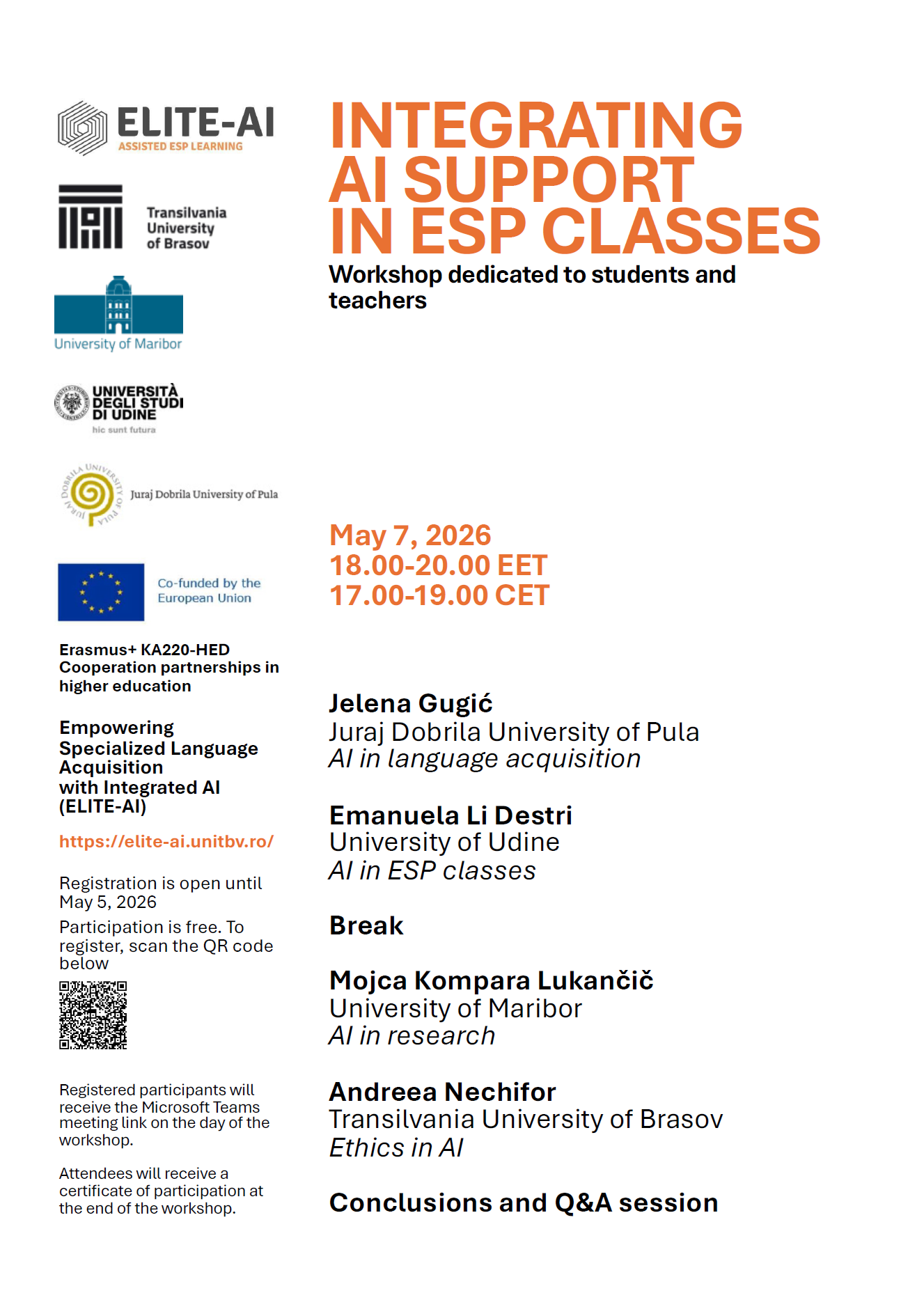
Integrating AI Support in ESP Classes - Workshop
The workshop is designed for both students and teachers, and aims to promote knowledge exchange, critical reflection and collaborative exploration of innovative approaches to foreign language (FL) and ESP instruction supported by Artificial Intelligence (AI).
Participants will engage with experts from multiple European institutions and examine emerging AI-driven practices in teaching, learning and assessment. In this context, the workshop will: explore the use of AI-powered tools in language acquisition across teaching, learning and assessment processes; present ESP learning practices empowered by AI tools, offering real-time feedback and personalized learning pathways; gather stakeholder feedback to support the co-development of innovative and applicable approaches to ESP instruction
Manual of Good Practices for Teachers and Students
Developed by the ELITE-AI team of researchers, teachers, and practitioners, this manual translates the project's classroom-based findings into a practical framework for the ethical and pedagogically sound integration of artificial intelligence in English for Specific Purposes (ESP) and foreign language instruction. Rather than promoting AI as a universal solution, it examines how teachers and students actually used AI tools across four European universities, what worked, what failed, and what conditions shaped meaningful learning outcomes.
Drawing on data collected from 1,870 observation and self-assessment forms, as well as the discussions and case studies presented during the ELITE-AI workshop Integrating AI Support in ESP Classes, the manual distils project findings into a set of concrete principles, classroom strategies, and reflective practices for both teachers and learners.
The manual is organised around six interconnected areas. It begins by addressing a foundational question: what role should AI play in the language classroom? The project findings consistently suggest that AI functions most effectively as an assistant rather than a substitute teacher, supporting pedagogical decisions rather than driving them. Subsequent sections explore lesson planning and classroom management in AI-enhanced environments, the impact of AI on language skills development and learner autonomy, assessment design and the critical evaluation of AI-generated content, ethical and academic integrity considerations, and a curated reference guide to AI tools commonly used in ESP contexts.
Throughout the manual, practical recommendations are linked directly to evidence gathered during the project. Particular attention is given to specialised vocabulary development, professional communication, speaking and listening practice, disclosure of AI use, and the growing importance of critical verification in an era of generative AI.
Each section concludes with a dedicated checklist, while a consolidated checklist at the end guides teachers and students through the full cycle of AI-supported learning, from course design and classroom implementation to assessment, disclosure, and end-of-semester reflection. The result is a resource intended not only for ESP teachers and students, but also for curriculum designers, educational practitioners, and institutional stakeholders seeking evidence-based approaches to AI integration in language education.