
Guidelines for Ensuring Quality in Language Acquisition with Integrated AI
The ELITE-AI Quality Assurance Manual, produced under Work Package 4, Activity A1 of the Erasmus+ project (Grant No. 2024-1-RO01-KA220-HED-000248845), serves as a framework to evaluate and ensure the effectiveness of integrating Artificial Intelligence into higher education. Developed collaboratively by four European institutions - Transilvania University of Brașov (UNITBV), University of Maribor (UM), University of Udine (UNIUD), and Juraj Dobrila University of Pula (UNIPU) - the manual establishes rigorous, empirically grounded guidelines drawn from over fifty experimental sessions. It bridges the gap between traditional instruction and AI-mediated classrooms by evaluating shifting instructional paradigms, pedagogical alignment, and the evolving dynamics between teachers, learners, and machine-generated content.
The framework synthesizes core theoretical methodologies, including English for Specific Purposes (ESP), Task-Based Language Teaching (TBLT), and learner autonomy. Key focus areas emphasize pre-lesson planning through intentional tool rotation, utilizing platforms such as NotebookLM, Gemini, Claude, and ChatGPT based on specific instructional needs, alongside active student prompt design and strict protocols for critical verification to mitigate the risks of uncritical AI acceptance. To evaluate classroom success, the manual features an Observation Sheet Framework that tracks longitudinal progress in target language use, content delivery, and the qualitative transformation of student participation from passive reception to self-regulated autonomy.
Ultimately, this document functions as both an evaluation toolkit and a professional development blueprint for language instructors within digital landscapes. It addresses crucial implementation benchmarks such as technical adaptability, curriculum differentiation, data privacy, and academic integrity. By establishing uniform quality criteria across the consortium, the manual ensures that AI-driven specialized language learning remains theoretically robust, ethically grounded, and fundamentally pedagogically meaningful.
Data Privacy, Fairness, Transparency and Responsible AI Use in ESP and Foreign Language Instruction
Developed under Work Package 4 of ELITE-AI, this manual gathers in one place the principles that should apply wherever AI tools are introduced into English for Specific Purposes and foreign language teaching: data privacy and informed consent, bias and equity of access, transparency and disclosure, pedagogical integrity and human agency, the ethical use of student data, and the professional development that makes any of the above workable in a real classroom rather than on paper.
Two bodies of evidence stand behind it, and the manual keeps them visibly distinct instead of folding one into the other. The first is external: the ethical frameworks published by UNESCO and the European Union, research-ethics guidance from the British Educational Research Association, and a comparison of how universities beyond the consortium, among them Stanford, Oxford, Cambridge and KU Leuven, have chosen to govern AI in their own classrooms. The second is internal, and it carries most of the manual's evidentiary weight: six months of AI-integrated classroom trials across four countries under Work Package 3, and the stakeholder workshop for policy makers held online on 17 June 2026, where close to 95 participants from a dozen countries answered live polls, left open-text comments, and argued the harder questions from the floor.
The manual moves through three stages. Sections 2 to 6 lay out the ethical foundations, international, European and disciplinary, and translate each into guidance a teacher or an institution can act on. Sections 7 to 9 report what actually happened: what the consortium observed in its own WP3 classrooms, what policy makers said when asked to vote and argue in real time, and how comparable universities abroad have answered the same governance questions. Sections 10 to 12 close with post-workshop questionnaire evidence, a professional-development agenda built directly from the 86% of respondents who called for mandatory ethics training, and a consolidated checklist organised under the nine headings the project's activity plan specifies.
Consistent with the three manuals that preceded it in this series, the Quality Assurance Manual, the Manual of Good Practices for Researchers, and the Manual of Good Practices for Teachers and Students, this is a practical companion rather than a legal text, and it does not replace institutional data-protection or research-ethics review. It is written for the audience Activity A2 specifies: educators, administrators, and the policy makers who will shortly receive its companion volume, the Manual of Good Practices for Policy Makers, at the close of the project.
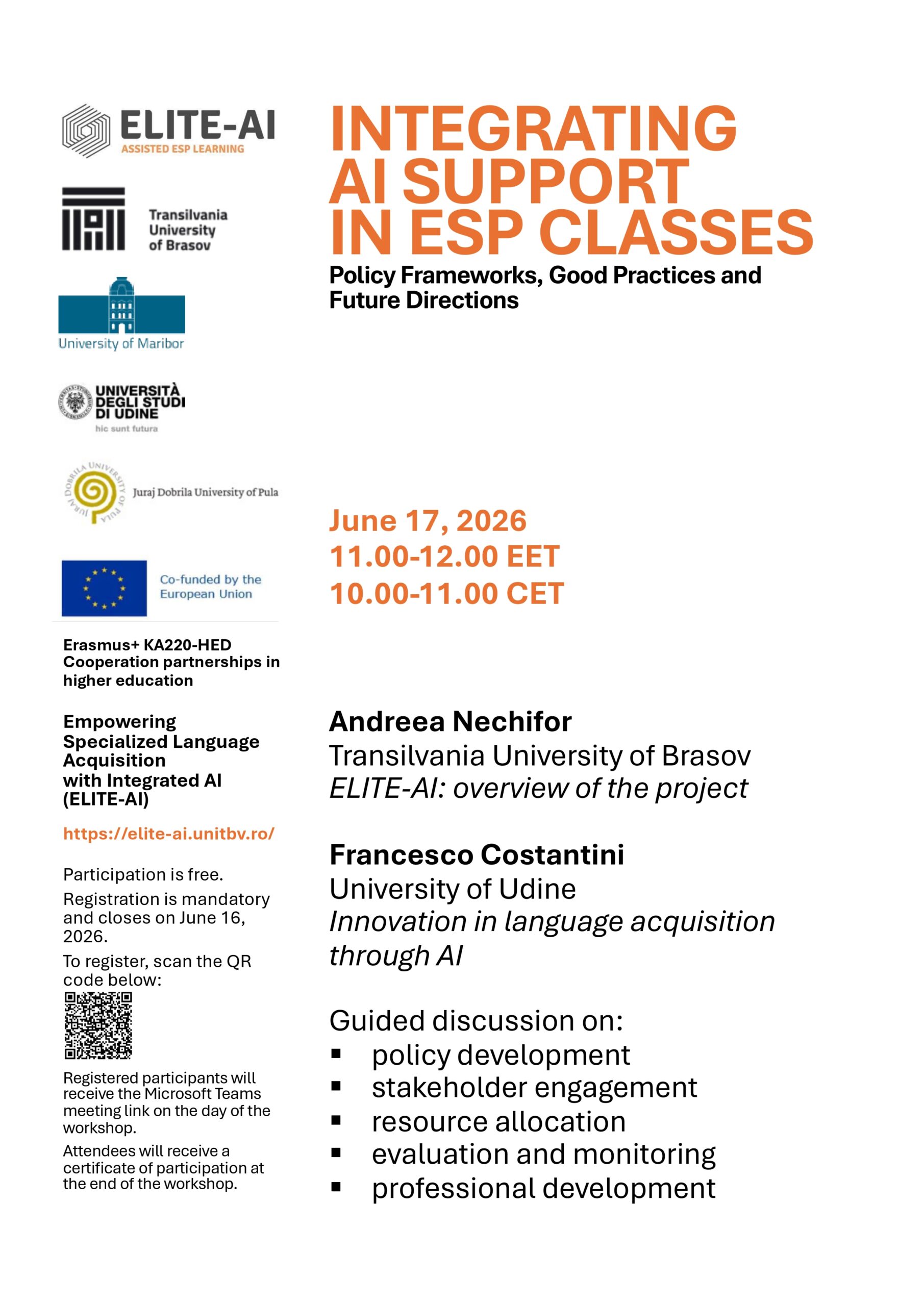
Call for participation
AI Integration in ESP Education: Policy Frameworks, Good Practices and Future Directions
Online Workshop for Policy Makers
17 June 2026
11:00 - 12:00 EET
10:00 - 11:00 CET
Integrating AI Support into Educational Policy and Practice
The last of the five good-practice manuals produced under Work Package 4 of ELITE-AI, this volume addresses the people who set the conditions classrooms operate under: ministry officials, rectors and institutional leadership, quality-assurance and legal offices, and the department heads who approve or write AI-related rules. It is organised around the five components named in the project proposal: policy development, stakeholder engagement, resource allocation, evaluation and monitoring, and professional development, each treated as a governance problem in its own right.
Its starting point is the distance between use and governance. OECD figures for 2025 - 2026 put student adoption at around 95% of undergraduates in the UK, while only 19% of institutions worldwide report a formal AI policy. ELITE-AI's workshop for policy makers of 17 June 2026, with close to 95 participants from a dozen institutions and countries, found the same gap in participants' own words: one institution had no regulations at all, another a policy that never left the committee that wrote it, a third a mandate issued without training. Three different failures, and none solved by a better-worded document.
Rather than a model policy, the manual offers comparative practice - Stanford, Cambridge, KU Leuven, Edinburgh, and the national arrangements surveyed by the OECD - alongside the consortium's own evidence: six months of trials across four countries, 1,870 observation-sheet responses, and workshop polls in which 86% of policy makers called for mandatory ethics training and lack of AI literacy outranked both regulation and funding as the main barrier. Section 8 gathers everything into a single working checklist. Read alongside its companion volume, the Ethical Provisions Manual, it gives institutions a way to close the governance gap in their own context: decentralise what should be decentralised, consult before mandating, fund training as seriously as access, and revise on a fixed schedule.